

FACTORY-TO-JOBSITE SCOPE
High-Impact Material Categories for Direct Multifamily Sourcing
Not every screw and stick of EMT conduit should be direct-procured—rough commodities and specialized code-stamped MEP gear often remain best paired with licensed trade labor. Direct procurement delivers its biggest financial and schedule payoff on repeatable, high-dollar architectural finishes and fixtures scaled across 20 to 400+ units.
At 3F Construction, our home-office procurement team manages direct sourcing across both overseas factories and vetted local Chicago manufacturers/fabricators:
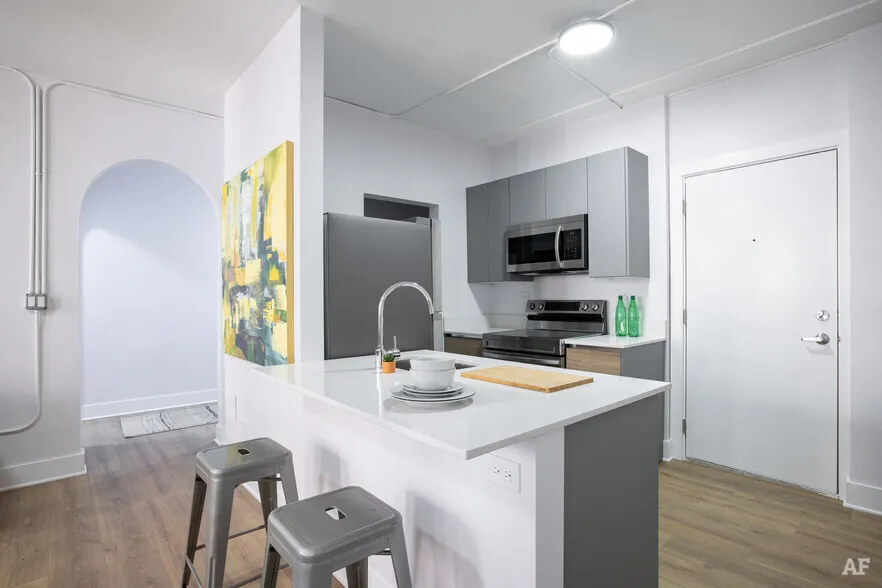
- Kitchen & Bath Cabinetry: Direct container-load or bulk local factory runs of plywood-box shaker or contemporary frameless cabinetry—such as the custom Turkish-made cabinetry 3F sourced for Mayan Lagoon’s 82 units in Rogers Park—eliminating showroom and dealer margins.
- Pre-Fabricated & Slab-Engineered Quartz Countertops: Buying factory-cut pre-fabricated quartz blanks or partnering directly with local stone fabricators on optimized slab nesting cuts both material cost and installation cycle time.
- LVT Plank Flooring, Wide-Plank Laminate & Porcelain Tile: Direct mill and overseas factory purchasing of commercial-wear-layer LVT (e.g., 20 mil), acoustic underlayment, and large-format porcelain wall/floor tile (including 24"×48" porcelain slab-look bath tile).
- Plumbing Trim, Undermount Sinks & Lighting Packages: Standardized, code-compliant (cUPC/NSF/UL-listed) faucets, pull-down kitchen sprayers, shower trim kits, vanities, mirrors, and LED fixtures bought in unified project lots.
- Drywall, Doors & Hardware Bundles: Bulk manufacturer/supply-house buyouts of drywall, solid-core doors, and matching lever hardware across multi-building portfolios to lock pricing ahead of inflationary spikes.
REAL 3F CASE STUDIES
Dimensional Value Engineering: Turning Waste Into NOI
True value engineering never reduces what the resident sees and touches—it redesigns invisible dimensions and manufacturing specs so ownership stops paying for dumpster waste. Two real 3F Construction Chicago projects demonstrate how procurement and design work hand in hand:
- River City (448 Units, South Loop — The Wolcott Group): During a six-month preconstruction diligence period with management, design, and leasing, 3F reviewed kitchen elevations against standard raw quartz slab sizes. By adjusting cabinet run dimensions by just a few inches with a local fabricator, we engineered kitchens that utilized entire quartz slabs with virtually zero offcut waste—improving countertop efficiency by 85% across hundreds of apartments.
- Mayan Lagoon (82 Units, Rogers Park — 36 Management): Transforming a severely distressed four-story cast-in-place concrete property required elevating finish perception without blowing the rent-supported budget. By combining early preconstruction value engineering with overseas and bulk direct procurement, 3F delivered 24"×48" porcelain tile-clad bathroom walls, wide-plank laminate flooring, pre-fabricated quartz countertops, and custom Turkish cabinetry at a cost well below standard Chicago market pricing.
PROTECTING THE SCHEDULE
Managing Lead Times, Tariffs, Freight & Dual-Sourcing Risk
Direct overseas procurement—whether from manufacturers in China, Turkey, Vietnam, or Europe—delivers meaningful savings on 50- to 400-unit programs, but only when managed with disciplined preconstruction planning. Ordering containers late or ignoring tariff and port-congestion buffers can wipe out material savings in a single month of lost rent.
At 3F Construction, we match sourcing geography to project timeline and run a hybrid domestic/overseas matrix so no renovation wave is ever hostage to a single shipping container.
Direct Procurement Lead-Time & Risk-Mitigation Matrix
| Material Category | Typical Lead Time (Domestic vs. Direct Overseas) | 3F Risk & Quality Mitigation Protocol |
|---|---|---|
| Custom / Semi-Custom Cabinets | 4–6 weeks domestic / 10–14 weeks overseas container | Lock shop drawings during preconstruction; approve physical sample door/finish board; order 3%–5% extra doors/hinges/toe-kicks. |
| Quartz Countertops (Pre-Fab or Slab) | 2–4 weeks local fabricator / 8–12 weeks pre-fab overseas | Laser-template mock-up unit first; nest layouts to full slab yield; inspect color lot consistency across shipments. |
| LVT Flooring & Porcelain Tile | 2–3 weeks regional mill / 8–12 weeks factory direct | Confirm single dye-lot production runs; verify STC/IIC acoustic ratings for Chicago condo/high-rise compliance; hold 5%–7% attic stock. |
| Plumbing & Electrical Trim Fixtures | 2–4 weeks domestic / 8–10 weeks direct OEM | Verify UL, cUPC, NSF/ANSI 61 lead-free, and Chicago DOB plumbing valve compliance BEFORE cutting POs (zero unapproved valves on-site). |
For tight-turn acquisitions starting within 30–45 days of closing, 3F uses a split-wave buyout: local/domestic stock covers Wave 1 units while lower-cost factory-direct containers arrive in time for Waves 2 through completion.
50+ UNITS/MONTH LOGISTICS
Preconstruction Buyouts, Warehouse Staging & Unit Kitting
Buying bulk materials early creates one immediate challenge in dense Chicago neighborhoods: you cannot drop four 40-foot shipping containers in a Lakeview alley or Edgewater courtyard. Solving last-mile staging is what turns procurement savings into jobsite speed.
Once buyouts are locked in Planswift and Sage Estimating and approved by ownership, bulk materials ship to a Chicagoland staging warehouse where items are inspected for freight damage immediately upon arrival, logged into inventory, and palletized into complete apartment "unit kits" (e.g., Unit 304 Kitchen + Bath Kit). Box trucks deliver two weeks of kitted units at a time directly to the building’s designated staging unit, keeping corridors clear and ensuring every crew walks into an apartment with 100% of its parts waiting.
Direct Material Procurement Checklist for Multifamily Owners
- Freeze finish specifications and approve physical sample boards (cabinet door, quartz cut, LVT plank, tile, hardware) at least 90–120 days ahead of overseas waves.
- Verify all plumbing rough-in valves, fixtures, and electrical lighting carry mandatory U.S. and City of Chicago certifications (UL, cUPC, lead-free) before deposit release.
- Audit total landed cost—including factory EXW/FOB price, ocean freight, customs brokerage, current Section 301/applicable tariffs, drayage, and Chicagoland warehouse storage—against domestic alternatives.
- Build a mock-up apartment using exact production materials to confirm cabinet clearances, quartz seams, and trim fit before authorizing bulk factory production.
- Reserve 5%–7% standardized "attic stock" (LVT planks, tile boxes, cabinet doors, faucets, hardware) stored on-site so property maintenance can execute future resident turns seamlessly for years.
- Align lender draw rules for "stored materials" upfront (warehouse COI, bill of sale, photo verification) so early deposits and container shipments fund smoothly without tying up sponsor cash.
PORTFOLIO-SCALE OPERATIONS
Spec Standardization & Long-Term Warranty Control Across Portfolios
For institutional owners operating multiple Chicagoland buildings—or executing a 300-unit value-add program over 18 to 24 months—direct procurement delivers an operational dividend long after construction finishes: SKU standardization.
When every studio, one-bedroom, and two-bedroom shares the exact same cabinet hinge, cartridge-style faucet valve, quartz edge profile, LVT locking system, and LED trim color temperature, property management maintenance costs drop sharply. Replacement parts sit in a single on-site attic-stock cage, warranties are tracked centrally in Procore closeout manuals, and future lease turns take days instead of weeks.
Interactive Planning Tool & Preconstruction Review
Model Your Chicago Multifamily Renovation ROI
Test per-unit renovation budgets, projected rent premiums, yield on cost, and cap-rate value creation with our Chicago Multifamily Renovation ROI Calculator — or walk your property with 3F Construction’s developer-led preconstruction team.
Verification & Primary References
Official Sources & Citations
Regulatory standards, fee schedules, and statutory references cited in this guide are verified against primary municipal, state, and federal publications.
- 3F Construction Preconstruction & Material Procurement Services
3F Construction — Details on 3F’s direct procurement, Planswift/Sage estimating, and dimensional value engineering.
- 3F Construction Mid-Market Summit 2026 Industry Q&A
3F Construction / Kiser Group Mid-Market Summit — Direct labor, material procurement, HPAC alternatives, and Chicago cost-control case studies.
- City of Chicago Department of Buildings — Construction Codes & Material Compliance
City of Chicago Department of Buildings — Municipal code standards governing plumbing, electrical, and building material approvals in Chicago.